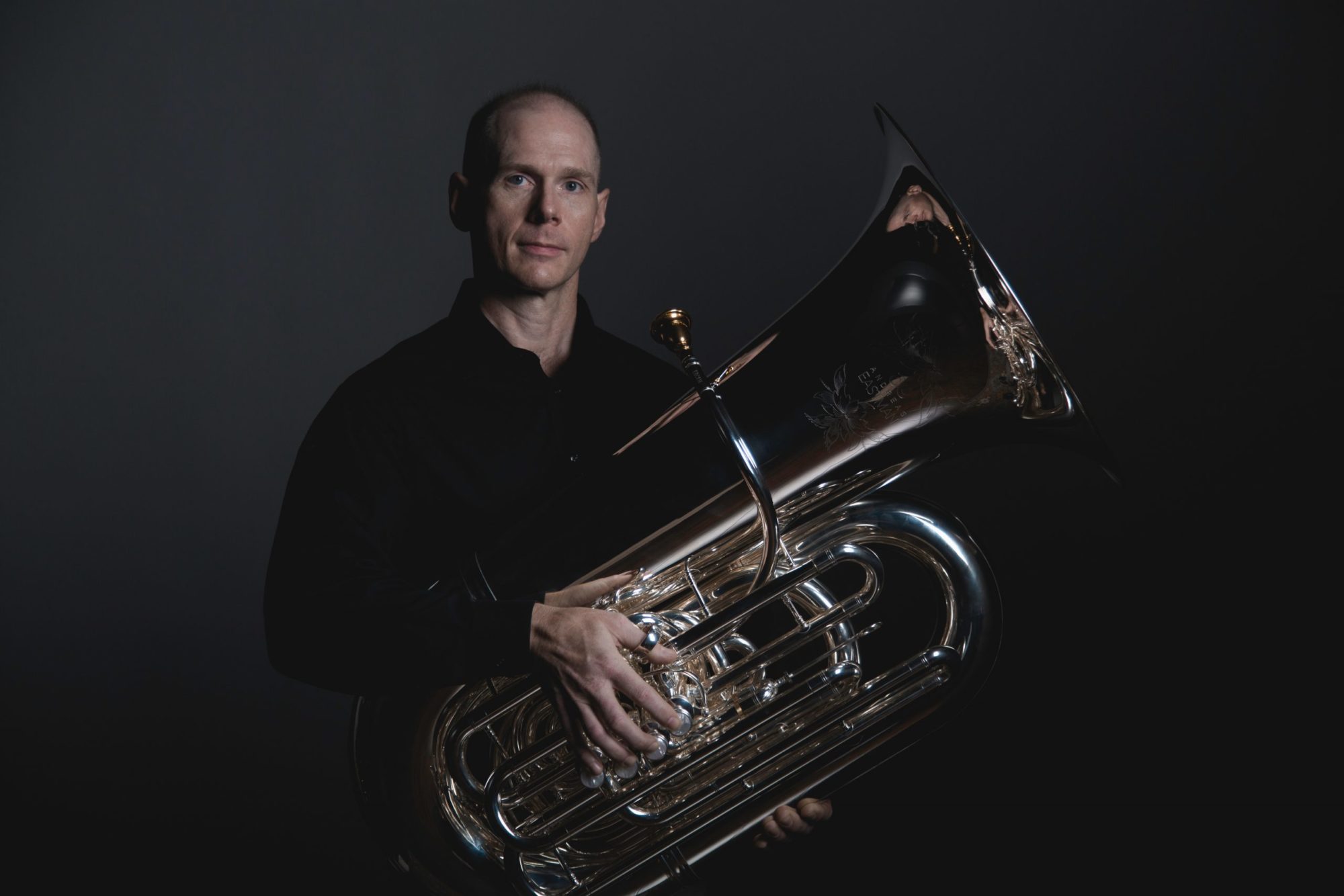


I often receive questions or see online discussions about certain myths that have surrounded the “Big Tuba.” For the purposes of this post, the overwhelming majority of the time, people are specifically referring to a 6/4, piston-valve CC tuba, in the tradition of the York model made famous by Arnold Jacobs and later approximated by the Holton Company. These two instrument designs have provided the basis for the majority of the currently existing models by various manufacturers. I won’t go into listing the brand name’s models and which design they are based on, but it’s relatively easy to see which are based on the York design and which are based on the Holton. Suffice it to say that the York and Holton designs are different enough that they can’t really be described as the “same instrument,” but they can be discussed together when addressing the “Myths of the Big Tuba” that surround the 6/4 Piston CC tuba platform. Finally, it’s also important to recognize that these observations are dependent on the quality and consistency differences of construction between the various manufacturers. Honestly, both designs are very well executed and represented by the current manufacturers.
Myth #1: ”They are hard to play, have difficult response, and make a woofy and unfocused tone.”
First…EVERY TUBA IS A COMPROMISE. Players should choose their instrument based on their own preferences, strengths, weaknesses, and playing situations. Second, the player should base their choice on what their performing situation or employment outcome is. For example, if they want to audition for a major orchestra position in a German orchestra, they would be well served by choosing a high-quality rotary Bb as their contrabass tuba.
If a player is in the market for a large CC tuba with piston valves, there are MANY fine examples available in today’s market. However, assuming quality construction and faithful adherence to either of the aforementioned designs, they are generally very easy to play and wonderfully responsive. By this I mean, that they will offer the player the qualities they desire when searching for a large tuba. Quite a bit more volume and tone, relative to smaller instruments. It’s basic acoustics. A larger amplifier (i.e. bell and branches for the tone to develop) will yield more volume than a smaller one, for the same amount of initial output from the player. An elementary example is speaking out loud, then repeating this while cupping one’s hands over their mouth to amplify the voice.
Now, with a more efficient amplifier comes certain compromises. The player has to understand that the amplifier in question doesn’t distinguish between “good” and “bad” signals when amplifying. It will merely amplify what is put into it on the player’s end. Of course, based on the particular design, and materials it’s constructed from, it will also impart certain tonal characteristics that may be deemed more or less desirable by the player. I personally find that the York design imparts a more rounded and balanced amount of low, mid, and high overtones in the sound. It also tends toward a more “omnipresent,” less directional sound. The Holton design seems to develop a more densely packed middle overtone focus, and can really project that tone quality into a large acoustic. The above observations are based on having played dozens to 100’s of examples of the various models over the last 25+years and owning NUMEROUS samples.
However, both of these designs are capable of overlapping with the opposite tonal qualities, depending on the individual player’s sound concepts, personal physical characteristics, and mouthpiece choices. Mouthpiece choice can make a HUGE difference…but not nearly as much as the player’s personal sound concept. I find that my personal sound concept is VERY focused and bright and not well served by choosing a Holton based design. I bring a lot of focus and brilliance to my playing, based on physical attributes and tonal preferences, and the York design seems to “knock the rough edges” off of the end result. When I played tubas based on the Holton design, I was immediately “noticed” in a less than ideal way by my colleagues on stage and the “Maestro” on the podium. Conversely, I’ve taught and known players that naturally produced a more diffuse and darker sound that were VERY well served by choosing the Holton based designs. That design brought a clarity and focus to their playing that they naturally seemed to lack and were searching for.
What both of these designs are bringing to the table, in terms of playability and response, are a short leadpipe, smaller bore size (compared to rotors), and recently, consistent high quality assembly along with lighter sheet brass construction. All of these lend to lively response, clear articulation, and rapid development of tone in the room. It also lends to a more secure “slotting” of middle and upper partials. Players wanting to use a contrabass tuba for the majority of their playing will find this combination of features ideal for their purposes. A testament to their potential for clarity, responsiveness, and playability is the overwhelming number of players using both of these designs successfully in auditions in the US for major orchestras and military bands. Many of these players are of smaller physical stature and yet still chose these models for their everyday playing and auditioning. These designs do not reward “physicality,” but rather clarity of input and relaxation from the player. If this design was inherently “hard to play, woofy sounding, and inefficient,” the consumer market would have long since spoken and indicated that there was no place for an “impractical” design. Quite the contrary…these designs have been setting sales records globally for the better part of 30 years.
Many critics of this category of instrument point to the sharp increase in demand for these models as evidence of a new phenomenon based on “Internet personalities, a few high profile professionals, and college professors” unduly influencing upcoming generations of players, and not any inherent value in the playing and tonal qualities these models possess. Meanwhile, they ignore the fact that this design traces its roots back to the beginning of the 20th century and was only interrupted because of the war effort in the US during the 1940s. With the rise to prominence of the Chicago Symphony Brass section under Reiner and Solti, the desire to possess one of these types of tuba only grew. Unfortunately, the capacity to produce these material and labor intensive instruments had been co-opted by other industries in the US, and it fell to a few individuals that specialized (to varying degrees of success) in cutting and reconstructing existing samples from BBb to CC. These same critics point to the dominance of traditional German rotary tubas in the US from the 1960s through the 1990s as evidence of their inherent superiority, rather than a lack of options for the US consumer, post-WWII. Indeed, the strong interest in the 6/4 piston CC tuba and its playing and tonal qualities spawned efforts beginning in the 1980s in Switzerland and culminating in the 1990s in Germany with a successful resurrection of this design. Continued refinement of the design, along with improved manufacturing methods has been rewarded by continually increasing sales and expansion of manufacturers offering these models around the World.
**Caveats**
The low register is “Different…”
While there are many very fine players that demonstrate a remarkable ability to play in the low range with extraordinary skill, neither of these designs possess an inherently friendly low range. This is due to the acoustic phenomenon that results from designing a 6/4 bugle pitched in CC utilizing the bore-map of currently existing designs. This seems to carry over to both rotary and piston 6/4 designs. Any tubist that is coming from a smaller Bb or CC tuba will immediately notice that the low range seems to be a bit more “problematic” when transitioning. A very important point that should be pointed out is the “partial series” where this occurs is the same as on the German style rotary F tuba. Anyone that chooses the German style rotary F tuba will be keenly aware of the instability that is generally associated with the corollary register. To be clear, on 6/4 CC tubas, this starts around low Ab and goes to around low F. On German rotary models, this starts around Db below the staff and goes to around low Bb. What’s the common theme? The 6/4 sized bugle. I believe that there’s an inherent acoustical mismatch between the bugle length and the bore sizes that are used in these respective designs. But, players that choose the 6/4 piston CC or 6/4 rotary F make the decision to learn “how to play” in this register. It usually involves the player leaning into the instrument’s resistance to stabilize the affected notes, commonly referred to as the “shift.” This technique is not necessary, but can be very useful when playing in the affected range.
Why doesn’t this seem to occur as much with BBb and Eb and smaller CC and F tuba models? My speculation and real world experience indicates that it is due to the inherent increase in airstream resistance through the valves, relative to the length and size of the bugle tapers and when and where the valves are placed on the instruments. Most German rotary F tuba manufacturers are now either offering smaller bugles or adding a 6th valve to increase the resistance to the airstream. Anyone that has played a true 6/4 sized BBb rotary tuba (I have) will agree that the same register, low Gb to low Eb, is similarly challenging.
However, with the consistent interest in the 6/4 CC design, companies have successfully developed much improved models. I’d expect this trend to continue. Leadpipe tapers and newer valve designs continue to improve this register on these designs. If the player decides they don’t want to deal with this challenge, choose a smaller sized instrument and make a different compromise. Every tuba is a compromise…
Myth #2: “They cause chop problems.”
This is one of the most common statements/questions I hear. Again, referencing the above comments, this is related directly to the fact that the larger 6/4 amplifier does its job very well. If the player is used to playing a less efficient amplifier and is not as aware of the problems they have at a fundamental playing level, when they pick up a larger amplifier, that instrument will shine a “Spotlight” on their weak areas of playing and cause distress. This “WTH” moment can often lead to a panic on the part of the player. This doesn’t always happen immediately with new 6/4 CC tuba players. It often comes after the “honeymoon” period of ownership, when the muscle memory from the previous, smaller tuba wears off, and the player doesn’t have a firm foundation in playing and is not adept at doing a self-diagnosis of “what’s really going on” in their playing. Almost without fail, it can be directly traced to the player’s lack of ability to accurately buzz on pitch and pre-hear the pitches they want to play. Since the larger instrument amplifies this problem, the player develops an increased awareness and frustration with the “inaccuracy, shaking tone, and unclear articulation” that is associated with this “Big Tuba Myth.” To add insult to injury, the somewhat unstable low register of these designs can combine to make the player think they have some sort of “chop problem.” A light-hearted analogy might be if someone were regularly making their wardrobe and grooming decisions using a handheld mirror. Then they decided to purchase a floor-length mirror…they didn’t suddenly develop “style and grooming problems.” They simply finally got the full picture of what was going on
The answer? Develop good solfège and aural skills and couple that with a healthy and accurate buzz, on AND away from the tuba. Ear training and good breathing habits, along with accurate pre-hearing of the “tuba in the head” will mitigate the problems that these players encounter when playing a large tuba. Merely returning to a smaller instrument will not address the underlying problems. It simply “turns the volume down” on the issues. Arnold Jacobs was purported to have described his 6/4 CC tubas as “Old Man tubas” for their ability to aid his playing well into his later years of life.
Myth #3: “They are woefully out of tune.”
This one is the most amusing to me. Every tuba design has its individual pitch tendencies and challenges. The more successful designs manage to find a good balance of sharp and flat open partials/harmonics, while offering options for alternate fingering combinations or tuning slide adjustments, based on the valve set designs. In my opinion, this is where the 6/4 piston CC tuba really shines. With its tuning slide arrangement and 4+1 piston and rotor combination, the player has almost endless options for adjusting pitch, shading tone and response, and facilitating efficient execution of technical passages. On the more recently produced versions, the open partial intonation tendencies are easily within acceptable ranges on almost every note. In fact, the lone example that comes to mind of a consistently “troublesome” note is the open ‘C4’ above the bass clef staff. It trends sharp, and this holds true, regardless of the manufacturer. Some samples more than others, and I’m sure there exists examples where this isn’t the case, but this seems to be an inherent “quirk.” Beyond that, I find that critics of this style of tuba decry its “miserable intonation” flaws while simultaneously describing its tone as woofy and lacking center. In my experience, the more woofy or unfocused the tone a tuba produces, the less apparent intonation discrepancies are to the player and listener. I find that the York-style instruments possess a very well defined pitch center and in fact reward the player for playing in tune with other instruments by creating wonderfully resonant unisons, octaves, and chords in a large ensemble setting.
In many instances, players that struggle with intonation on these models also tend to have issues described in “Myth #2” above. Another common trait amongst critics (pitch-police) of these tubas is their familiarity with a very different type or design of tuba. They simply try to play the 6/4 piston CC tubas the same way as their personal instruments, not realizing that they are adjusting for pitch tendencies that don’t exist or are opposite of what they expect, thus creating the problems themselves. Most of them base their observations on a very limited amount of playing time, and in less than ideal acoustics, such as music shows or conferences.
This isn’t to say that the 6/4 piston CC tuba has perfect intonation, but rather to say it’s certainly no worse than most any other design available, and well within acceptable standards for use at the highest professional levels.
Summary:
There has never been a time where the tubist has had more options for styles, keys, and designs of tuba available to them. It’s a really exciting situation that most players embrace. In this new era of innovation, designers and their factories often revisit older, historical designs to understand why they either disappeared or continue to be in demand. The York and Holton 6/4 CC designs have continued to be in demand almost since their inception. With continually improving manufacturing methods, along with improved valve designs and materials, these models have come to be regarded as one of the benchmarks of the industry for tubists around the World.
Anyone who has found that these tubas represent their “musical voice” should embrace that realization, pick their favorite brand, buy one they love, and get to the business of making music.